



How to clean lamps, chandeliers and lampshades – a guide by material (glass, brass, rattan, fabric, paper)
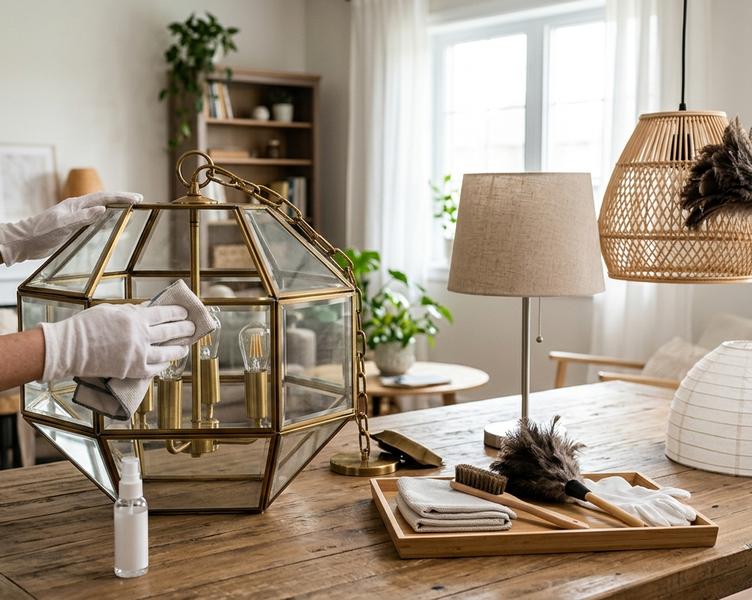
A glass shade covered in water spots after washing, brass with dark stains from “home-made” polishing, a paper lantern warped by a damp cloth. Most damage done while cleaning lamps comes from one mistake: every lamp gets washed the same way. Glass tolerates water and washing-up liquid. Lacquered brass does not tolerate baking soda or vinegar. Paper should never come into contact with water at all. Lamps with integrated LEDs need yet another approach. In this guide we go through the safety rules first, and then material by material: clear and opal glass, crystal, brass and gold finishes, matte black, rattan, paper, fabrics and LED fixtures. At the end you will find a “what to clean with – what to avoid” table, a sensible cleaning schedule and a checklist that lets you refresh your lamps before the holidays in about 30 minutes.
Table of contents
- Before you start: power, temperature and the ladder
- A home lamp-cleaning kit
- Clear and opal glass – how to wash a shade without water spots
- Crystal – how to clean a chandelier
- Brass and gold finishes
- Matte black and powder-coated metals
- Rattan, wicker and bamboo
- Paper lampshades and lanterns
- Fabric lampshades
- Lamps with integrated LEDs
- Table: material – what to clean with – what to avoid
- How often to clean lamps and quick everyday dusting
- Checklist: pre-holiday lamp cleaning in 30 minutes
- Summary
- FAQ
Before you start: power, temperature and the ladder
A lamp is an electrical device usually hanging out of arm’s reach, so two risks – electric shock and falling – matter more than the choice of cleaning liquid. A few rules are worth treating as a permanent ritual, whether you are wiping a wall light or washing a multi-arm chandelier.
Disconnect the power
Simply unplug floor and table lamps. For ceiling and wall fixtures, switching off the light switch is enough for dusting the outside, but if you are going to work with a damp cloth near the lamp holders, unscrew bulbs or remove shades – switch off the relevant circuit breaker in the fuse box. A switch is sometimes wired incorrectly and breaks the neutral wire instead of the live one, in which case the lamp holder may still be live. Before switching off the breaker, have a torch or a lamp on another circuit ready.
Wait for the lamp to cool down
Halogen and traditional bulbs get very hot, but LED fixtures give off heat too – especially their heat sinks and metal housings. Cold water on hot glass can weaken it, and a cleaning agent on a hot surface evaporates too quickly and leaves streaks. A safe standard is to wait at least fifteen minutes, and longer for powerful fixtures. An unscrewed bulb should be comfortable to hold in your hand.
Work safely on a ladder
A swivel chair or a bar stool is the most common cause of falls at home when cleaning lamps. Use a stepladder with a spreader lock, placed on a level, dry floor. Occupational safety rules work at home too:
- climb up and down facing the ladder, keeping three points of contact – two feet and a hand or a foot and two hands;
- do not lean out to the sides – your torso should stay between the ladder’s side rails, and if you have to reach too far, it is better to climb down and move the ladder;
- on a stepladder, do not stand on the two top steps unless it is a platform designed for standing;
- do not hold a full bowl of water in your hands – pass damp cloths up from below or hang them on a hook by the ladder;
- with a large chandelier, ask a second person to steady the ladder and take the removed shades from you.
Spread a blanket or a thick towel under the chandelier. It will catch drops and cushion any crystal you might drop. Before you dismantle anything, take a photo with your phone – it will save a lot of guesswork when reassembling.
A home lamp-cleaning kit
For almost every lamp in the house, a few things you probably already have are enough:
- two or three microfibre cloths – one for washing, one for drying, a third for polishing; terry and paper towels shed lint and leave fibres behind;
- mild washing-up liquid – a few drops in a bowl of lukewarm water;
- distilled water – for rinsing glass and crystal, as it does not leave white limescale deposits;
- isopropyl alcohol – mixed with water for crystals and the final polishing of glass;
- soft brushes and a toothbrush – for weaves, threads and ornaments;
- a vacuum cleaner with a brush attachment and adjustable suction power;
- a lint roller – for fabric lampshades;
- cotton gloves – with crystals and polished glass they prevent fingerprints.
A golden rule that will come back in every section: apply the product to the cloth, not directly to the lamp. Sprayed liquid gets into lamp holders, cable entries and gaps in the housing, and from there it does not evaporate so easily.
Clear and opal glass – how to wash a shade without water spots
Glass is the most rewarding material to wash, but it also shows mistakes most mercilessly: every hard-water deposit and every streak from greasy detergent is visible once the light is on.
Clear shades
If the shade can be removed, wash it in a bowl of lukewarm water with a drop of washing-up liquid, using a soft sponge or microfibre. Scourers with a rough side, cream cleansers and abrasive pastes leave micro-scratches on glass that look like haze once the bulb is lit. Greasy dirt – typical of kitchen lamps above the hob – is better soaked for a few minutes than scrubbed. Do not put shades in the dishwasher unless the manufacturer explicitly allows it: harsh detergent and high temperature can dull the glass and damage decorative edges.
Opal, milk and satin glass
Opal globes and milk-glass shades are one of the most fashionable choices today – we write more about why they diffuse light so well in our article on milk-glass lamps and the Soft Minimal and Quiet Luxury trends. When it comes to care, they have two features worth remembering.
First, milk glass with a matte, satin surface easily picks up greasy fingerprints and residue from shine products, which look like darker spots against a white shade. That is why plain water with a minimal amount of detergent and very thorough rinsing work best here, without products containing wax or silicone. Second, opal globes often have a metal fitting or collar glued on. Do not immerse such a shade completely – wash it with a cloth, and only wipe the area around the glue lightly with a damp microfibre.
The insides of milk-glass shades collect dust and dead insects, which cast clear shadows when the light is on. For globes with a narrow opening, a microfibre cloth wrapped around a wooden spoon or a soft bottle brush works well.
How to wash a glass lampshade without water spots
- Wash the shade in lukewarm water with a drop of washing-up liquid.
- Rinse it with clean water – preferably distilled. Tap water, especially hard water, leaves white limescale dots as it dries.
- Do not leave the glass to dry on a rack. Dry it immediately with an absorbent microfibre cloth and polish it with a second, dry cloth.
- If streaks remain, wipe the glass with a microfibre cloth dampened with a solution of one part isopropyl alcohol to three–four parts distilled water. The alcohol evaporates quickly and leaves no marks.
- Put the shade back on wearing cotton gloves or holding it through a cloth.
Crystal – how to clean a chandelier
A crystal chandelier loses its sparkle gradually, so we often only notice when the difference is large. You can choose between two methods – a quicker one without dismantling, and a more thorough one that involves taking the lamp apart.
Cleaning without removing the crystals
This method works well for regular care and for chandeliers with many small elements that would be very time-consuming to hang back up.
- Switch off the power, wait for the lamp to cool down and spread a blanket underneath.
- Remove dust with a soft duster or dry microfibre. Start at the top – dust falls onto the lower parts.
- Prepare a solution of isopropyl alcohol and distilled water in a 1:3 or 1:4 ratio. An alternative is water with a small amount of white vinegar.
- Put on cotton gloves, dampen a cloth (or the fingertips of the gloves) with the solution and wipe crystal after crystal.
- Polish each element straight away with a dry microfibre cloth. When the gloves get damp, put on a fresh pair.
- Only switch the power back on when the lamp holders and all elements are completely dry.
The popular “wet” method of spraying a chandelier and leaving it to drip dry is tempting because it is convenient, but it is risky – the liquid runs down into the lamp holders. If you do use such a product, cover the holders with plastic bags and lay plenty of towels under the lamp.
Thorough washing with dismantling
Every now and then – for example before the holidays – it is worth taking down the hanging elements. Photograph each tier and lay the crystals on a towel in the same arrangement in which they hung. Wash them in batches in lukewarm water with a mild detergent, rinse in a second bowl of distilled water and dry by hand with microfibre. Avoid hot water and sudden temperature changes. Small pendants slip out easily, so line the bottom of the bowl with a cloth. With crystal decorations on a metal frame, first check what metal the structure is made of – more on that in the next section.
Brass and gold finishes
This is the material with which it is easiest to cause irreversible damage, because the internet is full of “proven” polishing methods – baking soda, vinegar, lemon, ketchup. They do work, but only on raw brass. Most modern lamps, however, have a protective coating for which these same methods are deadly.
First identify the finish
- Lacquered brass – shiny, uniform, “glassy”, does not darken for years. It is covered with a clear lacquer that protects the metal from oxidation. Polishing is not needed.
- Raw (unlacquered) brass – has a softer sheen, develops a patina over time and darkens where it is touched by hands. It can be polished.
- Electroplated, PVD and lacquered gold coatings – found on most modern gold lamps, including brushed models. This is a thin layer on another metal; polishing can wear it through to the base.
- Plated elements – steel or another metal coated with brass. A simple magnet test helps identify a steel core: solid brass does not attract a magnet, steel under a coating does. Remember that the test will not detect a coating on aluminium or zinc alloy.
If in doubt, treat the lamp as lacquered. This is the more cautious approach – in the worst case, raw brass will stay slightly dull instead of losing its coating.
What to clean a brass lamp with so as not to scratch it
Wash lacquered brass and gold coatings only with lukewarm water and a drop of mild washing-up liquid, applied with a soft microfibre cloth. Wipe, remove the detergent residue with a cloth dampened with clean water and dry immediately. Do not use hot water, as it can weaken the lacquer. Also avoid baking soda, vinegar, lemon juice, polishing pastes and cream cleansers. Baking soda acts like a fine abrasive: it leaves micro-scratches in the lacquer through which moisture gets in, and the brass begins to darken under the coating in characteristic, spreading stains. These can no longer be cleaned – the only option left is stripping the lacquer and restoration. Vinegar and lemon, being acids, damage coatings in a similar way.
Gold lamps are a strong accent in interiors today – if you are looking for ideas on how to combine them with the rest of your décor, take a look at our guide on gold lamps in interiors. In terms of care, regular dusting with a dry microfibre cloth and an occasional wipe with a damp cloth are all they need.
Home remedies for patina – raw brass only
If you are sure the brass is not lacquered (e.g. an old chandelier with a patina), you can turn to acidic home remedies:
- a paste of flour, salt and vinegar – applied in a thin layer for about 10 minutes, then gently wiped off with a soft cloth;
- lemon juice with salt and water – to soak a paper towel, which is then laid over the dirty spots;
- ketchup or toothpaste – for lighter tarnish, with the help of a soft toothbrush in the ornaments.
Always start with a test in an inconspicuous spot. After each method, wash off the acid residue very thoroughly with water and dry the metal – acid left behind will keep acting on the surface. Be careful around cables, lamp holders and glued elements, and remove crystals before applying pastes.
Matte black and powder-coated metals
Matte black owes its deep, almost velvety look to a microscopic surface texture that scatters light. That is exactly why it is sensitive to friction: intensive scrubbing smooths this texture and a permanent shiny patch appears on the lamp.
For everyday care, a dry, soft microfibre cloth is enough. For heavier dirt, use a cloth lightly dampened with water and a mild pH-neutral cleaner, and then dry the surface – on black, dried drops leave light marks. Avoid cream cleansers and powders, melamine sponges, rough scourers, products containing bleach, ammonia or alcohol, and polishing products. Use the same method for powder-coated lamps in other colours – white, graphite or beige.
Rattan, wicker and bamboo
Woven shades filter light beautifully and cast patterned shadows, but their weave acts like a sieve for dust. If you are considering such a lamp or want to learn more about the differences between materials, take a look at our guide to lamps made of natural materials – rattan, paper and linen.
Cleaning a rattan lamp step by step
- Dry vacuuming. Use a vacuum cleaner with a soft brush attachment and reduced suction power. Strong suction can pull loose fibres out of the edges of the weave.
- A brush deep into the weave. Sweep out dust lodged in the crevices with a dry paintbrush or a soft toothbrush, moving in the direction of the fibres.
- Damp wiping – only when necessary. Dampen a cloth with warm water and a little mild soap and wring it out very well. Wipe quickly, then dry immediately with a dry cloth.
- Quick drying. Put the shade in a warm, airy place. Avoid drying it on a radiator or in full sun – the fibres may warp, crack or fade.
Rattan and wicker should not be soaked or washed under running water. Prolonged moisture weakens natural fibres and encourages mould, and water alone can make wicker turn grey. Some manufacturers recommend only a dry cloth without any detergents – if the lamp came with instructions, check them before the first wet cleaning. Lacquered or painted shades are easier to maintain: simply dust them and wipe them with a damp and then a dry cloth.
Paper lampshades and lanterns
Paper – rice paper, handmade paper, parchment or pleated paper – is the most delicate material used in lamps. One rule comes before all others: no water. Moisture causes warping, water marks, seams coming unstuck and a weakened structure, and wet wipes or sprays leave stains that cannot be removed.
- Dust with a soft-bristled duster, a clean dry brush or a dry microfibre cloth. Start inside the shade, then move to the outside.
- Recesses and pleats can be swept out with a brush or a vacuum cleaner with a brush attachment set to the lowest power and held slightly above the surface.
- Grey smudges and fingerprints on light-coloured paper can be carefully removed with a soft eraser or a dry-cleaning sponge (used, among other things, for soot and lampshades).
- Hold rice-paper lanterns by the frame, never by the covering itself – the paper wrinkles and tears easily.
Paper shades turn yellow in sunlight, so avoid placing them where the sun shines for most of the day. If a lampshade is permanently stained or yellowed, replacing the shade is a better solution than risky attempts at washing it.
Fabric lampshades
How do you clean a fabric lampshade? Before you reach for water, work out how the lampshade is made. This matters more than the type of fabric itself.
Glued or sewn lampshade?
Most lampshades have the fabric glued onto a rigid backing made of plastic or cardboard. Such a lampshade must not be soaked – the glue gives way under warm water and the backing warps. Sewn lampshades, stretched over a metal frame without a backing, can usually be hand-washed, unless the manufacturer says otherwise.
Dusting
The most effective tool is a lint roller – it picks up dust from the fibres instead of smearing it. An alternative is a vacuum cleaner with an upholstery brush on low power. Dust the lampshade on both sides, moving the roller from top to bottom.
Stains and freshening up
On glued lampshades, treat stains locally: dampen a microfibre cloth with water and a little gentle fabric detergent, wring it out well and dab the stain gently instead of rubbing hard. Then wipe the area with a cloth dampened with clean water and leave it to dry. Sewn lampshades can be washed in a bowl of lukewarm water with a mild detergent for delicate fabrics, turning them in the bath. Then rinse, shake off excess water and dry with an absorbent towel.
Velvet requires particular care: dust it with a soft brush, and if the lampshade is sewn and washable – wash it by hand at around 30°C, without rubbing or wringing. Once it has dried in an airy, shaded place, gently brush the pile with a clothes brush. Whatever the material, do not dry lampshades on a hot radiator or in full sun, and do not put them back on the lamp until they are completely dry.
Lamps with integrated LEDs
In a lamp with integrated LEDs there is no bulb to unscrew – the diodes, circuit board and power supply (driver) are permanently built into the fixture. This applies to most LED ceiling lights, modern pendant lamps with rings or linear bars, and many wall lights. The electronics inside are sensitive to moisture, which is why the cleaning rules here are stricter than for classic fixtures.
What you can do
- Dust the housing and diffuser with a dry microfibre cloth or a duster – this is enough in most cases.
- For heavier dirt, wipe the outer surfaces with a cloth lightly dampened with clean water, wrung out very well, and dry immediately.
- Remove the shade or diffuser if the manufacturer provides for this in the instructions (e.g. clips or a bayonet fitting), and wash it separately – away from the fixture.
- Only switch the power back on when all elements are completely dry.
What not to do
- Do not soak or spray the fixture. Apply the product only to the cloth. Liquid that gets into the gaps can damage the LED board or the driver.
- Do not take apart the LED module or the driver housing. Manufacturers state explicitly that opening the fixture can compromise its seal and voids the warranty. There is no need to look inside the module during normal cleaning.
- Do not touch or wipe the diodes and the board themselves if they are exposed – gently removing dust with a dry brush is enough.
- Do not use solvents, abrasives or harsh chemicals. Diffusers are often made of plastics (acrylic, polycarbonate) that can turn dull, yellow or crack when exposed to alcohol or solvents.
It is also worth checking the IP rating stated on the fixture or in the instructions. Typical living-room lamps are IP20 – the second digit “0” means no protection against water whatsoever. Even IP44 bathroom fixtures are splash-proof, but not designed to be washed under a stream of water.
Table: material – what to clean with – what to avoid
| Material | What to clean with | What to avoid |
|---|---|---|
| Clear glass | Lukewarm water with a drop of washing-up liquid, rinsing with distilled water, immediate drying with microfibre; for streaks – a solution of isopropyl alcohol and water | Cream cleansers and abrasive pastes, rough scourers, air drying, the dishwasher without the manufacturer’s approval |
| Opal, milk and satin glass | Water with a minimal amount of detergent, a soft sponge, thorough rinsing, drying | Shine products with wax or silicone, immersing shades with a glued-on fitting |
| Crystal | Isopropyl alcohol with distilled water 1:3–1:4 on a cloth, cotton gloves, polishing with dry microfibre | Spraying lamp holders, hot water, terry and paper towels |
| Lacquered brass, gold coatings, PVD | Lukewarm water with a mild detergent, wiping with clean water, drying | Baking soda, vinegar, lemon, ketchup, polishing pastes, hot water |
| Raw brass | Mild detergent for everyday care; for patina, a paste of flour, salt and vinegar or lemon with salt – after a test, with thorough rinsing | Wire wool, rough sponges, leaving acid residue on the metal |
| Matte black, powder coating | Dry or lightly damp microfibre, pH-neutral cleaner, drying | Melamine sponges, cream cleansers, alcohol, bleach, polishing |
| Rattan, wicker, bamboo | Vacuum cleaner with a brush on low power, paintbrush, well-wrung cloth, quick drying | Soaking, washing under the tap, drying on a radiator or in the sun |
| Rice paper, handmade paper, parchment | Duster, dry brush, dry microfibre, soft eraser, dry-cleaning sponge | Water, sprays, wet wipes, squeezing the shade |
| Fabric (linen, cotton) | Lint roller, vacuum cleaner with a brush, spot cleaning with microfibre and a mild detergent; sewn shades – hand washing | Soaking glued lampshades, bleach, drying on a radiator |
| Velvet | Soft brush; sewn lampshades – hand washing at approx. 30°C, drying in the shade | Rubbing, wringing, tumble dryer |
| Lamps with integrated LEDs | Dry microfibre or a cloth lightly dampened with clean water; removable diffuser washed separately | Spraying, immersing, solvents, opening the housing and module |
How often to clean lamps and quick everyday dusting
Regular, quick dusting is more effective than infrequent, thorough washing. Dust left for weeks combines with grease from the air (especially in the kitchen) and forms a sticky layer that can no longer be picked up with a dry cloth. The schedule below is a practical starting point – adapt it to your home:
- Every week or two – quick dusting of all lamps during regular cleaning: a duster for crystals and metal, a lint roller for fabric lampshades, a brush for rattan and paper.
- Every month – damp wiping of glass shades and metal frames, dusting the inside of shades and removing insects.
- Every one to two months – more thorough cleaning of crystal chandeliers without dismantling.
- Once or twice a year – thorough washing with dismantling: crystals, removable shades, washing sewn lampshades.
- More often in the kitchen – lamps above the hob and island are worth wiping even every week, before the greasy film has time to harden.
Everyday dusting also has a practical side: dusty shades and bulbs let through less light, so the room seems darker even though the lamp works perfectly. A good habit is to keep an electrostatic duster on a telescopic pole somewhere within easy reach – then wiping ceiling lamps takes a few minutes and does not require getting out the ladder.
Checklist: pre-holiday lamp cleaning in 30 minutes
Before the holidays there is no need to take every chandelier apart. This sequence lets you refresh the lighting in the living room, dining room and hallway in about half an hour:
- Minutes 0–3: preparation. Switch off the lamps (when working near lamp holders – the circuit breaker), get the ladder ready, a blanket under the chandelier, two microfibre cloths, a bowl of lukewarm water with a drop of detergent and a bottle of alcohol and distilled water solution.
- Minutes 3–10: dust from top to bottom. Dust all lamps dry: a duster for chandeliers and metal, a lint roller for fabric lampshades, a brush for rattan and paper. Start with the highest fixtures.
- Minutes 10–17: glass and crystal. Remove small shades, wash them in the bowl, rinse and dry straight away. Wipe the crystals in place with a cloth dampened with the alcohol solution and polish them dry.
- Minutes 17–22: metal. Wipe gold, brass and black frames with a well-wrung cloth with water and detergent, then dry. No pastes, baking soda or vinegar.
- Minutes 22–26: bulbs and LED lamps. Wipe cool bulbs with a dry or lightly damp cloth. LED lamp housings and diffusers – only with a dry or barely damp microfibre cloth.
- Minutes 26–28: check. Put the shades back on, check that everything is dry and securely fastened, and that small crystals are hanging in their places.
- Minutes 28–30: light test. Switch the power on and look at the lamps once lit – streaks and dried drops are most visible then. Touch them up with a dry microfibre cloth.
Summary
How do you clean lamps without damaging them? First identify the material, then choose the method – not the other way round. Glass and crystal tolerate water and detergent well, as long as you rinse them with distilled water and dry them immediately. Lacquered brass, gold coatings and matte black only need a mild detergent and a soft cloth – leave the home-made pastes for raw brass. Clean rattan and fabrics mainly dry, and paper – only dry. Wipe lamps with integrated LEDs on the outside, and never spray or take them apart. On top of that: the circuit breaker, a cooled-down fixture and a stable ladder. If you add a quick dusting every week or two, the thorough pre-holiday cleaning will be fast, and your lamps will keep their just-bought look for longer.
FAQ
How do you clean a glass lampshade without water spots?
Wash the shade in lukewarm water with a drop of washing-up liquid, rinse it with distilled water and dry it immediately with an absorbent microfibre cloth – do not leave it to dry on its own. Water spots are most often limescale from hard water or detergent residue. If streaks remain, wipe the glass with a cloth dampened with a solution of one part isopropyl alcohol to three–four parts distilled water and polish with a dry microfibre cloth. Put the shade back on wearing cotton gloves so as not to leave fingerprints.
How do you wash a fabric lampshade?
First check whether the fabric is glued to a rigid backing or sewn onto the frame. Dust a glued lampshade with a lint roller or a vacuum cleaner with a brush, and remove stains locally with a well-wrung microfibre cloth and a mild detergent – without soaking, because the glue will give way. A sewn lampshade can be washed by hand in lukewarm water with a detergent for delicate fabrics, rinsed and dried with a towel. Dry it in an airy, shaded place away from the radiator, and only put it back on the lamp once it is completely dry.
What should you clean a brass lamp with so as not to scratch it?
Most modern brass and gold lamps have a lacquer or electroplated coating, so lukewarm water with a drop of mild washing-up liquid, a soft microfibre cloth, a wipe with clean water and thorough drying are enough. Do not use baking soda, vinegar, lemon, polishing pastes or rough sponges – they scratch the coating and can lead to dark stains under the lacquer. Home-made pastes of flour, salt and vinegar or lemon with salt are suitable only for raw, unlacquered brass, always after a test in an inconspicuous spot.
How do you dust a rattan lamp?
Use a vacuum cleaner with a soft brush attachment set to low power, and sweep dust out of the depths of the weave with a dry paintbrush or toothbrush, following the direction of the fibres. Clean rattan with a damp cloth only when necessary: with a cloth dampened with warm water and a little mild soap, wrung out very well, and then dry it immediately. Do not soak the shade and do not dry it on a radiator or in full sun. If the manufacturer recommends dry cleaning only, stick to those instructions.
Can you wash an LED lamp with water?
A lamp with integrated LEDs is not washed with water in the sense of soaking or rinsing. After disconnecting the power and letting the fixture cool down, you can wipe its housing and diffuser with a cloth lightly dampened with clean water, wrung out well, and then dry it thoroughly. Do not spray the lamp, immerse it or open the housing or the LED module – this risks damaging the electronics and voiding the warranty. A removable shade can be washed separately, away from the fixture, and put back on only once it is completely dry. Typical household fixtures with an IP20 rating have no protection against water at all.